
The most common question we get at the RENO shop isn't "which truck do you drive." It's "what does 4,500 lb working load limit actually mean, and is it enough for my dirt bike." This guide is the long answer. It covers every anchor type we make, how to read the WLL number, and the math you actually need to know before you buy.
A "tie-down D-ring" sounds simple. It's a piece of metal you hook a strap to. In practice, it's one of the most mis-specified pieces of hardware on a truck — and the failure mode is a 600-lb dirt bike sliding into your cab at 60 mph. So this guide starts with the basics, then walks through the four D-ring types, the six anchor types, the math behind WLL, and the four mistakes we see every weekend at the trailhead.
What a "D-ring" actually is (and why it's not a D)
The name is wrong. Most "D-rings" in off-road and truck-bed applications are actually closed-loop clevis shackles — U-shaped, not D-shaped. The "D-ring" label comes from the cross-section of the metal bar, which forms a D when you look at the end. The actual shape is a U-bend with a removable or fixed pin through the two ends. This naming confusion is one reason shopping for the right anchor is harder than it should be.
For the rest of this guide, "D-ring" means any closed-loop anchor that a strap or shackle can clip into. That includes the bow shackle, the clevis pin, the stake-pocket loop, and the welded-on D plate. The math is the same for all of them. The mounting is different.
The four D-ring types
Every D-ring on a truck or trailer falls into one of four categories, and each has a different install, a different WLL range, and a different failure mode. Pick the wrong one and you'll either over-build (and pay for hardware you don't need) or under-build (and break something at the worst possible time).
1. Bolt-on D-ring (stake pocket insert)
The most common aftermarket D-ring. Threads into the factory stake pocket of a truck bed rail. No drilling, reversible, WLL typically 4,500-10,000 lb. This is the workhorse of the bed-anchor world because it uses hardware the truck already has.
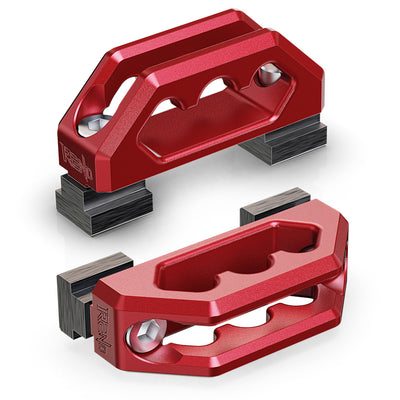
RENO Bed Rail Cleats (aluminum 7075, 2-pack) — the standard 4,500 lb WLL bolt-on. Direct fit for Tacoma / Tundra / Gladiator. The reason we make these in 7075 aluminum specifically: the threads don't seize after a winter of road salt, which is the #1 failure mode of steel cleats in coastal states.
Best for: bed cargo tie-down, removable without tools, light to medium loads (up to about 800 lb per anchor in practice).
Avoid for: tow recovery, high-strap-angle applications, anything that pulls sideways on the cleat.
2. Weld-on D-ring (bed floor or frame)
Welded permanently to the bed floor or the frame rail. WLL can run 5,000-12,000 lb depending on weld quality and parent metal thickness. The strongest anchor you can put on a truck, but also the one that requires the most commitment — if you weld it wrong, you're patching the bed.
The 3rd Gen Tacoma bed floor is 0.045 inches thick in the middle of the floor, thicker at the structural ribs. Do not weld to the 0.045 floor panel without a backing plate — the heat will distort the panel, and the weld will eventually crack as the panel flexes. Weld only to the frame rails or to the bedside rails (which are 0.06-0.08 inches and properly supported).
Best for: dedicated work trucks, race applications, anything that pulls in a direction the bolt-on can't handle.
Avoid for: leased trucks, anything you might want to return to stock.
3. Removable-pin D-ring (clevis shackle)
Looks like a bow shackle. The pin unscrews or unclips, the strap clips around the bow, the pin goes back in. WLL typically 3/4" pin = 4,750 lb, 1" pin = 8,000 lb. The most flexible anchor because the pin size determines the strength, not the bow itself.
RENO 3/4" D-Ring Shackle (7075 aluminum, 7/8" pin, 2-pack) — bow shackle, 4,750 lb WLL on the 3/4" body. Aluminum body, 7075 alloy, stainless pin. Used both as a recovery point and as a flexible tie-down. The advantage of the bow over the fixed D: the bow rotates to align with the strap, which means the strap isn't bending the metal.
Best for: recovery, multi-angle tie-down, anything where the strap needs to articulate.
Avoid for: permanent mounting (it's removable on purpose, so it can walk).
4. Hitch-mounted D-ring (receiver shackle)
A D-ring that lives in the 2" receiver hitch. WLL ranges from 6,000 lb (light-duty) to 35,000 lb (military-spec). The receiver itself is one of the strongest mounting points on a truck — a 2" receiver hitch is rated for 6,000 lb GTW and 600 lb tongue weight, and the steel walls are 0.25-0.375 inches thick.
RENO 2" Receiver Shackle Hitch (7075 aluminum, 35,000 lb GTW) — the receiver-mounted anchor. CNC-machined 7075 aluminum body. This is the "I need a recovery point right now" anchor — slides into any 2" receiver, locks with a pin, and provides a 35,000 lb GTW rating.
RENO 2" Receiver Hitch with D-Ring Shackle Mount (6,000 lb GTW) — a more permanent option that combines a hitch receiver with a D-ring shackle mount. Lower GTW than the dedicated shackle (6,000 lb), but it's a hitch that doubles as an anchor.
Best for: recovery, trailer tow, anything where the back of the truck is the load point.
Avoid for: bed cargo (it's on the wrong end of the truck), light trucks with 1.25" receivers (use a 2" reducer and accept the lower WLL).
The six anchor types, and what each is good for
D-rings are the loop. Anchors are where the loop lives. The D-ring itself is a piece of hardware; the anchor is the system that holds the D-ring in place. The WLL of a D-ring is meaningless if the anchor it's mounted to can't handle the same load.
There are six common anchor types in the truck-bed and off-road world. Here's how they break down.
1. Stake pocket anchor
The factory stake pockets on most pickup beds (Tacoma, Tundra, F150, Gladiator, Ranger) are 1" square pockets with a threaded bung at the bottom. A stake pocket anchor threads into that bung. WLL = the D-ring's WLL, capped by the strength of the bung itself, which is typically 4,500 lb on a factory install.
Common failure: over-torquing the anchor and stripping the bung. Use a torque wrench, not an impact driver. The factory spec is usually 15-20 ft-lb.
2. Bed rail cleat
Like a stake pocket anchor, but mounted to the bed rail (the top edge of the bedside, not the floor). The bed rail is structurally stronger than the floor because it's a formed channel. WLL on a bed rail cleat can run 5,000-7,500 lb on a properly rated install.
RENO Bed Rail Cleats (Tacoma/Tundra/Gladiator fitment) — the most popular bed rail cleat we make. The cleat clamps over the rail with a T40 Torx, no drilling.
3. Bed floor anchor (bolt-on)
Bolted through the bed floor into a backing plate or the frame rail below. WLL depends on the bolt grade and the parent metal — a 3/8" Grade 8 bolt through a 0.06" bed floor is about 4,000 lb shear strength. Bolt to the structural ribs of the bed, not the flat sections between them.
RENO 3-in-1 Truck Tie Down Cleats — versatile option for bed floor, corner, or rear trunk mounting. 7075 aluminum, 4,500 lb WLL. The "3-in-1" form factor means the same cleat works in three different anchor positions.
4. Front tow hook / recovery point
The factory tow hook is bolted to the frame, typically behind the bumper. WLL ranges from 7,000-12,000 lb on a factory install and is the strongest anchor on the front of a truck. Aftermarket tow hooks (like the RENO Tacoma Front Tow Hook for 2009-2023 trucks) are direct OEM replacements with the same frame-bolt pattern but upgraded materials.
Tow hook anchors are for recovery, not cargo. The strap angle and the load profile are completely different from bed cargo. Don't use a tow hook to tie down a load — use it to pull a stuck truck out of mud.
5. Winch line point
On trucks with a winch, the winch line point is at the fairlead. WLL is the winch line's breaking strength, typically 8,000-12,000 lb for synthetic line and 15,000-30,000 lb for steel cable. The winch line point is the strongest single anchor on a truck, but it's also the most abuse-prone — synthetic line can melt under friction, steel cable can kink and fail.
RENO Winch Shackle Mount — flat winch hook connector that sits between the winch line and the bow shackle. CNC aluminum, 35,000 lb GTW. This is the connector that lets you run a soft shackle off the winch line without weakening either component.
RENO Winch Snatch Recovery Ring — for winch-line-to-strap connections. Aluminum body, 7075 alloy, 30,000 lb GTW. The ring spreads the load across both sides of the winch line rather than concentrating it on a single hook point.
6. Hitch receiver anchor (covered above)
The 2" receiver is covered in section 1.4 above. It's the sixth anchor type and the most flexible for the back of the truck.
Working Load Limit (WLL) vs break strength: the math
This is the section most people skip, and it's the section that actually matters. The number on the package is the WLL. The number the manufacturer tested to destruction is the break strength. They are not the same number, and the difference between them is the safety factor.
WLL = Break strength ÷ Safety factor
The standard safety factor for vehicle tie-down hardware is 3:1 for static loads and 5:1 for dynamic loads (anything that moves). So a D-ring with a 4,500 lb WLL has a break strength of about 13,500 lb (3:1 ratio).
The reason the safety factor exists: a moving truck sees shock loads that don't show up in the lab. A 600-lb dirt bike that hits a bump at 60 mph briefly puts 1,800-2,400 lb on the strap. Without the 3:1 factor, that 600-lb load would be just under the WLL of a 2,000-lb D-ring — and right at the break strength of a 4,500-lb D-ring that the lab tested to 13,500 lb.
The 5:1 rule for dynamic loads
For anything that bounces, sways, or accelerates (dirt bikes, ATVs, kayaks on a roof rack, a load of lumber), use the 5:1 safety factor. A 600-lb dynamic load needs a D-ring with a 3,000 lb WLL minimum. A 1,000-lb dynamic load needs a 5,000 lb WLL minimum.
The 3:1 rule for static loads
For static loads (a load that doesn't move — a pallet of bricks, a piece of furniture in a covered trailer), the 3:1 factor is fine. A 1,500-lb static load needs a 4,500 lb WLL D-ring, which is what most aftermarket cleats ship with.
Six example calculations
Here are six real-world loads and the WLL they need. Each assumes a 5:1 safety factor (dynamic) or 3:1 (static).
| Load | Type | Weight | Per-anchor (4-anchor load) | WLL needed | Recommended D-ring |
|---|---|---|---|---|---|
| Dirt bike | Dynamic | 600 lb | 150 lb | 750 lb | Bolt-on cleat (4,500 lb WLL) |
| ATV | Dynamic | 900 lb | 225 lb | 1,125 lb | Bolt-on cleat (4,500 lb WLL) |
| Kayak (single, on roof rack) | Dynamic | 80 lb | 40 lb | 200 lb | Bolt-on cleat (4,500 lb WLL) |
| Sheet of plywood + tools | Static | 300 lb | 75 lb | 225 lb | Bolt-on cleat (4,500 lb WLL) |
| Load of firewood (1/2 cord) | Static | 1,000 lb | 250 lb | 750 lb | Bolt-on cleat (4,500 lb WLL) |
| Race car on trailer (per corner) | Dynamic | 900 lb | 225 lb | 1,125 lb | Bow shackle, 1" pin (8,000 lb WLL) |
Notice that most light-duty loads don't come close to the WLL of a standard 4,500-lb D-ring. The reason we rate for 4,500 lb isn't because the loads are heavy — it's because the safety factor has to be there in case the load shifts. A 600-lb dirt bike on a 4,500-lb WLL D-ring has a 7.5:1 ratio, which is well above the 5:1 minimum. Plenty of room for the unexpected.
The four mistakes we see every weekend
These are the four mistakes that show up at the trailhead, at the track, and at the campsite. None of them are exotic. All of them are fixable.
Mistake 1: Using the OEM bed hook for cargo
The OEM bed hook on a 3rd Gen Tacoma is rated for 220 lb. That's a sleeping bag, not a dirt bike. If you're using the OEM hook to tie down a load, you're 10x under-spec'd. The fix is a bolt-on cleat — $50 and ten minutes per corner.
Mistake 2: Using a tow hook for cargo
The tow hook is for recovery, not cargo. The strap angle, the load profile, and the failure mode are all different. A tow hook used as a cargo anchor will either snap the hook (if overloaded) or twist the frame (if loaded at the wrong angle). The fix is to use a stake pocket or bed rail cleat for cargo and reserve the tow hook for what it's for.
Mistake 3: Trusting the printed WLL without checking the anchor
A 4,500-lb WLL D-ring mounted to a stripped stake pocket is a 0-lb WLL system. The D-ring is fine; the anchor is the weak link. Always check the anchor before you trust the printed number. Look for stripped threads, cracked welds, corrosion under the mounting plate, and any signs of pull-out.
Mistake 4: Mixing metal types
Steel D-ring on an aluminum bed rail cleat, or vice versa, creates a galvanic corrosion cell. In a salt-air environment (coastal states, winter road salt), the two metals will corrode faster than either would alone. The fix is to use the same metal for the anchor and the D-ring — both aluminum, or both steel.
Quick reference: the RENO anchor line by use case
Here's the cheat sheet for which RENO product to use for which job.
- Bed cargo, light to medium (up to 800 lb per anchor): RENO Bed Rail Cleats (aluminum, 4,500 lb WLL)
- Bed cargo, heavy or high-strap-angle: RENO Bed Rail Cleats (304 stainless, OEM-fit)
- Recovery, soft shackle connection: RENO 3/4" D-Ring Shackle or RENO Winch Snatch Recovery Ring
- Hitch receiver, recovery or tow: RENO 2" Receiver Shackle (35,000 lb GTW)
- Winch line connector: RENO Winch Shackle Mount
- Front recovery, Tacoma / 4Runner / Bronco / F150 / Tundra / Ram: RENO Front/Rear D-Ring Tow Hooks (vehicle-specific fitments)
- Box-link / floor anchor for F150 / F250 / F350 / Lightning: RENO Box-Link Tie-Down Anchors (4-pack)
Frequently asked questions
Q: What's the difference between a D-ring and a bow shackle?
A: A D-ring has a fixed loop (no moving parts). A bow shackle has a removable pin that lets the bow articulate. For multi-angle loads, the bow shackle is better because the strap doesn't have to bend the metal. For straight-pull loads, the D-ring is fine.
Q: Can I use a recovery D-ring as a tie-down?
A: Technically yes — recovery D-rings are stronger than cargo D-rings. Practically, recovery D-rings are more expensive, and the extra strength doesn't help a 600-lb load. Use the right tool for the job: cargo cleats for cargo, recovery shackles for recovery.
Q: What's the best anchor for a leased truck?
A: Bolt-on stake pocket or bed rail cleats. They don't require drilling, they come off without tools, and they leave the factory stake pockets intact. Weld-on and bolt-through-floor anchors will need to be patched at the end of the lease.
Q: How do I know if a stake pocket is stripped?
A: Thread a bolt into the bung by hand. If it spins freely without bottoming out, the bung is stripped. If it threads in smoothly and stops, the bung is good. A stripped bung needs to be either retapped (with a thread chaser) or replaced — don't try to use a stripped stake pocket for cargo.
Q: Is aluminum or steel better for a D-ring?
A: For the loop itself, aluminum (7075-T6 specifically) is the better choice for most applications: it's lighter, doesn't rust, and the threads don't seize. For the high-strap-angle anchors, 304 stainless steel is the better choice because the geometric load multiplier is high enough that aluminum fatigue becomes a real concern over years of use.
Q: What's the strongest bolt-on D-ring you make?
A: The RENO 2" Receiver Shackle Hitch (35,000 lb GTW) is the highest-rated bolt-on D-ring in the line. It's mounted to a 2" receiver, which is one of the strongest anchors on a truck. For bed-mounted bolt-on cleats, the 4,500 lb WLL is the practical maximum — the bed rail itself is the limit, not the cleat.
Q: Do I need a different D-ring for towing vs cargo?
A: Yes, in terms of geometry. Tow D-rings need to articulate to align with the tow strap (so a bow shackle is better). Cargo D-rings can be fixed because the cargo strap can be repositioned to align. Same WLL applies, but the geometry is different.
Q: What about D-rings for a soft shackle?
A: Soft shackles need a D-ring with a smooth, rounded inside surface — no sharp edges that would cut the UHMWPE line. Standard 3/4" bow shackles work. Pin-style D-rings (where the pin passes through a hole) will cut a soft shackle under load. The RENO Winch Snatch Recovery Ring is specifically designed for soft shackle compatibility.
The TL;DR
Most D-ring failures are WLL failures, not hardware failures. The hardware is fine; the rating was wrong for the job. Use the 5:1 safety factor for dynamic loads, 3:1 for static loads, and a 4,500-lb WLL bolt-on cleat will handle 95% of bed-cargo applications. For the rest, weld-on, hitch-mounted, and winch-mounted anchors scale up to the 35,000-lb range. Pick the anchor that matches the load, the geometry, and the truck — and check the anchor every oil change, not just the D-ring.
About RENO: renoallroads.com is a small offroad shop in the Bay Area. We've been designing, testing, and shipping tie-down and recovery hardware for trucks and SUVs for 8 years. Every product on the site is something we've run on our own shop trucks first. If you've got a question about your specific truck or load setup, drop us a line at team@renoallroads.com.